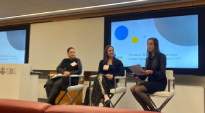
On Thursday, January 23, 2020, NIRI NY NextGen hosted members for an engaging panel discussion, “Personal Branding & Career Development,” held at UBS offices.
A presentation given by Nicole Briguet, Account Supervisor at Edelman, shared key tips on how to utilize LinkedIn. Afterward, the panel discussion with Tapestry leaders was moderated by Emily Mohr, Investor Relations of Chimera Investment Corporation. The panel featured:
-
Andrea Shaw Resnick – Global Head of Investor Relations & Corporate Communications at Tapestry, Inc.
-
Amy Nurnberg – Vice President, Global People and Organization Development, Tapestry, Inc.
Key takeaways include:
LinkedIn
- LinkedIn is an online rolodex of business contacts that is also used as a critical recruitment tool. It can also be used to provide industry relevant content and news.
- LinkedIn helps to showcase your professional brand. It communicates who you are in the workplace, and showcases your skills, experiences, and even personality traits.
- Increasingly individuals will include professional accreditations to their Name, such as CFA, CPA, IRC, etc.
- Ways to engage on LinkedIn include: connection requests to others, engaging in conversation by commenting/ liking/ sharing, or posting your own content through perspectives on what’s happening in your industry/ personal stories or experiences/ or news and announcements from your company.
Panel
- Encouraged to create a network with other IROs in your sector which you can then reach out to when looking for advice or feedback in industry specific situations.
- Within a mentee/ mentor relationship, make sure there are defined clear goals and lay out any ground rules. The mentor can help the mentee look at things in a different way, while the mentee is advised to be open to being encouraged on working on opportunity points.
- In regards to navigating a promotion or raise be prepared to provide supportive reasoning. Realize that the manager may ask themselves, are you ready for the next step (have you demonstrated the skills, are you performing in a similar way to the role you want, are you capable), and then also is there a role available at that time. It could be that you are ready and able, however that position is unavailable.
- Some key skills utilized in an IRO role are: finance and writing, presentation skills, having a perspective of an analyst/ portfolio manager, persuasiveness, ability to think strategically, ability to navigate different work, personality and communication styles.
- Highlighting the importance of having regular development conversations with your manager and having an open dialogue.